
Table of Contents
- The Physics of Luggage Compression: Volume vs. Mass Realities
- Cube Construction: 70D Ripstop, TPU Laminates, and Self-Healing Zippers
- Category I: Compression Mechanics & Air Evacuation (Hacks 1–5)
- Category II: Modular Luggage Architecture & Workflow (Hacks 6–10)
- Category III: Spatial Optimization & Cavity Packing (Hacks 11–15)
- Category IV: Wrinkle Prevention & Textile Protection (Hacks 16–19)
- Category V: Airport Security, Hotel Hygiene & Maintenance (Hacks 20–23)
- 2026 Packing Cube Comparison: Top Brands Tested
- Frequently Asked Questions About Packing Cubes
- Testing Standards and Textile References
The Physics of Luggage Compression: Volume vs. Mass Realities
Direct Answer: Packing cubes optimize luggage through two distinct physical mechanisms: geometric containment (converting amorphous fabric into standardized rectangular prisms) and air evacuation (dual-zipper mechanical compression forcing dead air from loose weaves). While compression cubes can reduce the physical volume of soft knit clothing by 30% to 45%, they do not reduce weight. Inexperienced travelers frequently overload compressed bags, fitting 35 liters worth of clothing into a 25-liter carry-on footprint and inadvertently exceeding airline cabin weight thresholds (such as the strict 7 kg / 15.4 lb limits enforced by European, Asian, and Australian carriers).
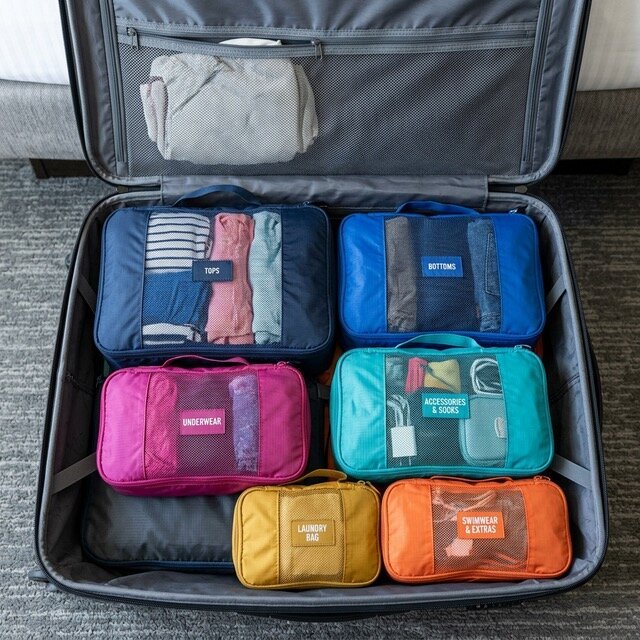
When loose garments are packed into a suitcase without compartmentalization, they shift during transit, settling into irregular lumps that leave unfilled voids along the corners while creating bulging high spots across the center. Packing cubes act as modular building blocks, enabling high-density volumetric stacking. Furthermore, when security officers conduct manual bag inspections, modular cubes allow agents to inspect gear without unraveling your entire wardrobe onto airport inspection tables.
Cube Construction: 70D Ripstop, TPU Laminates, and Self-Healing Zippers
Direct Answer: Premium packing cubes rely on three core textile technologies: high-tenacity 30D to 70D silicone-impregnated ripstop nylon (which delivers high tensile strength without adding weight), Thermoplastic Polyurethane (TPU) internal coatings (for odor and moisture isolation in active wear compartments), and inverted coil YKK RC (Racquet Coil) zippers designed to withstand intense lateral shear stress during compression.
Budget packing cubes constructed from heavy 600D polyester with coarse polyester mesh panels add unnecessary tare weight (up to 1.5 pounds for a set of four) while providing zero stretch or water resistance. In contrast, ultralight silnylon cubes weigh under 1.5 ounces (42g) per cube, slide smoothly against one another inside a packed bag, and resist snagging against zipper teeth.
Category I: Compression Mechanics & Air Evacuation (Hacks 1–5)
Direct Answer: Mastering mechanical compression requires understanding fabric compressibility. Knitwear, fleece, technical base layers, and merino wool compress dramatically because their porous weave traps massive volumes of atmospheric air; tightly woven Oxford cotton, raw denim, and structured suiting resist compression and wrinkle severely if forced.
Hack 1: The Finger-Guard Perimeter Glide
The primary point of failure on dual-zipper compression cubes is fabric snagging in the secondary compression track. When closing the perimeter compression zipper, slide your index finger along the inner edge directly ahead of the zipper slider. Your finger depresses bulging fabric away from the teeth, preventing torn hems and jammed sliders under high lateral tension.
Hack 2: The Two-Way Bodyweight Purge
Never rely solely on the mechanical leverage of the zipper slider to force air out of an overstuffed cube; doing so strips zipper teeth and bursts seam tape. Instead, close the primary compartment zipper, place the cube on a firm surface, kneel or press your chest down onto the center of the cube to physically expel trapped air, and pull the compression zipper closed while the cube remains flattened.
Hack 3: The Hybrid Roll-and-Fold Sorting Protocol
Pure rolling and pure flat-folding are both sub-optimal when used exclusively. Implement a hybrid protocol: “Ranger Roll” flexible knits (merino tees, athletic shorts, underwear, socks) into tight tubular cylinders that fill the bottom base of the cube, then flat-fold woven button-down shirts and trousers across the top layer to maintain clean fold lines and prevent hard creases.
Hack 4: The 80% Volume Rule (Preserving Insulation Loft)
Never compress high-loft down garments (down jackets, travel quilts) or synthetic high-loft fleece by more than 50% for extended transit. Packing high-loft insulation into extreme vacuum or compression cubes for more than 48 hours snaps the microscopic keratin barbules of down plumules, permanently degrading thermal efficiency. Pack down items loosely in a lightweight non-compression cube or stuff them into exterior coat pockets.
Hack 5: The “Chimney” Center-Loading Architecture
When packing a compression cube, arrange your densest garment rolls along the outer perimeter walls, leaving a slight depression or “chimney” down the center. Because the perimeter zipper pulls the edges inward, center-loading creates a bulging dome that resists compression; perimeter-loading distributes fabric bulk uniformly, allowing the compression zipper to close effortlessly.
Category II: Modular Luggage Architecture & Workflow (Hacks 6–10)
Direct Answer: Luggage architecture dictates how quickly you can retrieve items without disturbing surrounding gear. Grouping clothes by functional outfit capsules rather than rigid garment categories dramatically accelerates transit efficiency on multi-city road trips and overnight layovers.
Hack 6: The “First Night” Layover Module
Pack a single small cube containing everything required for your first night at a transit hotel: one set of sleepwear, a fresh change of underwear and socks for tomorrow, and your travel toiletry kit. When you arrive exhausted at your hotel room at 11 PM, you only unzip this single module, leaving the rest of your suitcase 100% sealed and ready for morning departure.
Hack 7: Dual-Sided Floating Divider Management
Upgrade to dual-compartment cubes equipped with an internal floating barrier (such as the Peak Design Packing Cube). As the trip progresses, clean garments on one side decrease in volume, while dirty clothes packed into the opposing side expand against the flexible partition. Clean and worn clothes remain completely separated without requiring extra cubes or plastic hotel laundry bags.
Hack 8: Color-Coded Family Luggage Allocation
When packing multiple family members into a single large 28-inch checked suitcase, assign a distinct cube color to each individual (e.g., Charcoal for Parent A, Sage Green for Parent B, Rust Orange for Child 1). This eliminates luggage clutter in hotel rooms; each family member simply lifts their assigned color module into their respective dresser drawer.
Hack 9: Outfit-Based Capsules for Fast-Moving Itineraries
If your trip involves changing hotels every single night (such as a driving tour through the Scottish Highlands or Iceland’s Ring Road), abandon category-based packing (all shirts in Cube A, all pants in Cube B). Instead, assemble complete daily outfits (shirt, underwear, socks, pants) inside individual medium cubes labeled “Day 1,” “Day 2,” and “Day 3.”
Hack 10: The In-Flight Emergency Carry-On Pod
Always pack one ultralight extra-small cube inside your personal item containing a complete emergency transit change (merino T-shirt, lightweight underwear, thin socks). If an unexpected flight cancellation forces an unscheduled airport overnight, or if overhead bin gate checks separate you from your primary rollaboard, your baseline hygiene remains intact.
Category III: Spatial Optimization & Cavity Packing (Hacks 11–15)
Direct Answer: Rectangular packing cubes naturally leave geometric voids when placed into suitcases with rounded corners and protruding trolley handle channels. Maximizing luggage density requires filling these dead air spaces with flexible secondary items before laying down main cubes.
Hack 11: The Trough-Filling Base Layer
The interior floor of rolling carry-on suitcases features two or three pronounced parallel ridges housing the aluminum telescopic handle tubes. Never place flat, rigid packing cubes directly on top of these ridges, which creates hollow air pockets underneath. First, roll soft undergarments, socks, charging cables, or flip-flops and tuck them into the sunken channels until the suitcase floor is perfectly level.
Hack 12: Corner Radius Triangulation
Commercial suitcases have rounded corners (typically a 2- to 3-inch radius) to comply with airline exterior dimensional gauges. Square packing cubes leave empty triangular wedges in all four corners. Stuff pliable items into these corner voids: a rolled rain jacket, packable umbrella, water bottle, or sunglasses case.
Hack 13: Tubular Slim Cubes for Perimeter Fencing
Invest in long, narrow tubular cubes (often designated as “tube cubes” or “shoe cubes” measuring roughly 13 x 4 x 3 inches). These slim organizers fit along the perimeter walls of your suitcase between the main cubes and the zipper track, taking advantage of vertical depth that standard rectangular cubes leave behind.
Hack 14: The Vertical Filing Cabinet Orientation
Never stack packing cubes horizontally like pancakes inside a deep suitcase or travel pack. Orient cubes vertically on edge, like file folders in a filing cabinet or vinyl records in a crate. This allows you to inspect and extract any single cube without disturbing or lifting the cubes surrounding it.
Hack 15: The Improvised Lumbar and Travel Pillow
During long regional train rides or commuter flights where you lack a dedicated neck collar, take a small packing cube filled with soft merino wool or fleece garments and slide it behind your lower back as an ergonomic lumbar support cushion, or wrap it in a scarf to serve as a supportive window pillow.
Category IV: Wrinkle Prevention & Textile Protection (Hacks 16–19)
Direct Answer: Wrinkles occur when moisture, heat, and mechanical pressure combine to deform fabric fibers past their elastic threshold. Using dry-cleaner plastic film as an anti-friction slip layer between woven garments inside packing cubes eliminates the fabric-on-fabric friction that causes deep creases.
Hack 16: The Plastic Dry-Cleaner Slip-Sheet Technique
When packing formal woven button-down shirts, linen trousers, or blazers inside a packing cube, interleave thin plastic dry-cleaner bags between each garment. The slick polyethylene film allows the fabrics to slide freely against each other during transit vibration rather than binding together and pressing creases into the weave.
Hack 17: Odor-Proof TPU Isolation for Damp Activewear
Never pack sweaty workout clothes, wet swimsuits, or muddy trail socks into standard breathable mesh cubes, which allow bacterial odor molecules and moisture to contaminate your clean wardrobe. Use an airtight, TPU-laminated seam-welded cube (such as the Thule Clean/Dirty Cube or Eagle Creek Isolate Clean/Dirty) to contain moisture and odor until laundry facilities are reached.
Hack 18: The Buffer Wrap for Fragile Souvenirs
If you purchase fragile artisanal ceramics, glassware, or local spirits while traveling, place the item inside a soft cotton pouch, then nestle it firmly in the exact center of a densely packed clothing cube. The compressed layers of clothing surrounding the object act as an impact-absorbing bumper far superior to thin bubble wrap.
Hack 19: Natural Fiber Breathing Management
While synthetic nylon and polyester thrive in airtight compression cubes, natural animal fibers like cashmere, alpaca, and heavy wool need slight atmospheric ventilation during multi-week trips to release moisture. For extended trips exceeding two weeks, store fine woolens in breathable mesh-faced cubes rather than hermetically sealed plastic compression bags.
Category V: Airport Security, Hotel Hygiene & Maintenance (Hacks 20–23)
Direct Answer: Packing cubes act as physical barriers against unsanitary surfaces in transit. They prevent airport screening tables and hotel dresser drawers from contacting your clean clothing while protecting your luggage zippers from premature mechanical wear.
Hack 20: The Rapid TSA Secondary Inspection Shield
If airport security agents flag your carry-on bag for secondary screening due to buried electronics, having your clothing sealed inside packing cubes prevents agents from touching your bare underwear or dumping loose clothing onto contaminated security counters. The officer can cleanly lift two or three cubes out, inspect the bottom of the bag, and slide the cubes back in seconds.
Hack 21: The Zero-Touch Hotel Dresser Transfer
Hotel dresser drawers are frequently overlooked by housekeeping staff and can harbor dust mites, residual carpet cleaner, or bedbug nymphs. Upon checking into a hotel, lift your packing cubes directly out of your suitcase and place them unopened into the dresser drawers. Simply unzip the top lid of each cube and fold it back—your clothes remain completely shielded from the wooden drawer surfaces.
Hack 22: High-Tension Zipper Wax Maintenance
Compression cube zippers endure massive lateral stress. Twice a year, scrub the zipper coils with an old toothbrush to remove lint and debris, then rub a block of pure beeswax or specialized dry zipper wax (such as Gear Aid Zipper Cleaner & Lubricant) along the teeth. This reduces slider friction by over 40%, preventing split coils and zipper separation under heavy loads.
Hack 23: The Matryoshka Nesting Storage Hack
When your trip concludes, do not let an empty set of 5 to 8 packing cubes clutter your closet. Unzip all cubes, lay them flat, and nest them inside the largest medium or large cube in your set like Russian Matryoshka dolls. Zip the outer cube closed: your entire organization system stores as a single compact, tidy 10 x 7-inch pouch ready for your next departure.
2026 Packing Cube Comparison: Top Brands Tested
Direct Answer: For maximum durability and seamless clean/dirty separation, the Peak Design Packing Cube system is the class leader due to its self-healing 70D nylon, tear-away zippers, and internal floating partition. For ultralight minimalist backpackers where every gram matters, the Eagle Creek Pack-It Isolate series provides unmatched strength-to-weight ratios.
| Brand & Model | Material & Weight | Compression Type | Special Features | Best Traveler Profile |
|---|---|---|---|---|
| Peak Design Packing Cube (Medium) | 70D Recycled Self-Healing Nylon 3.88 oz (110g) |
Dual perimeter zipper (expands 18L to 8L) | Floating clean/dirty divider; tear-away instant zip; ultra-durable. | Frequent flyers, one-bag travelers, gear enthusiasts. |
| Eagle Creek Pack-It Isolate Compression (M) | 50D Poly Ripstop with Protx2 2.6 oz (73g) |
Angled compression zipper track | Antimicrobial fabric treatment; translucent fabric; featherweight. | Ultralight backpackers and weight-restricted airline travelers. |
| Thule Compression Cube (Medium) | 100D Semi-Transparent Nylon 4.8 oz (136g) |
Heavy-duty perimeter compression YKK | Water-repellent coating; structured square corners maximize bin space. | Rugged road trips, adventure luggage, heavy pack loads. |
| Nomatic Compression Packing Cube | Ripstop Nylon with Mesh Gusset 5.1 oz (145g) |
Center wrap-around compression zipper | Extreme compression ratio; structured rectangular profile. | Urban business travelers using tech-focused backpacks. |
| Bagail / Amazon Basics (6-Piece Set) | 600D Coarse Polyester with Mesh 14.2 oz (402g total set) |
Non-compression (standard organizer) | Low cost; transparent mesh tops; heavy and non-water-resistant. | Occasional casual vacationers on a strict budget. |
Frequently Asked Questions About Packing Cubes
Do compression packing cubes really save significant space in a carry-on?
Yes, but primarily for soft, porous knit garments such as cotton T-shirts, athletic apparel, base layers, and fleece. Compression cubes mechanical force trapped air out through the fabric weave, reducing the physical depth of packed garments by 30% to 45%. However, they do not compress dense materials like shoes, toiletry bottles, electronics, or rigid jackets.
Can compression cubes cause permanent wrinkles in dress shirts and formalwear?
If tightly woven fabrics (such as 100% cotton poplin or linen) are tightly rolled and compressed under heavy lateral pressure, sharp compression wrinkles will form. For formal shirts, use the plastic dry-cleaner slip-sheet technique (Hack 16) or place dress shirts inside a dedicated structured garment folder with folding boards rather than an aggressive compression cube.
Are mesh packing cubes better than solid ripstop nylon cubes?
Mesh cubes allow you to see interior contents instantly and provide ventilation for humid garments. However, mesh tears easily when snagged on zippers, adds weight, and offers zero water resistance against rain or leaking toiletries. Solid 30D to 70D ripstop nylon cubes are lighter, more durable, slide into bags with less friction, and shield clothing from external spills.
How many packing cubes do I actually need for a one-week trip in a carry-on?
An ideal one-week carry-on setup consists of three to four cubes: one Medium Compression Cube (for pants, button-downs, and light sweaters), one Small Compression Cube (for T-shirts and shorts), one Small or Slim Tubular Cube (for socks and underwear), and one Water-Resistant / TPU Cube (for dirty laundry and workout gear).
How do I wash and clean my packing cubes after an international trip?
Never clean technical packing cubes in a washing machine with harsh chemical detergents or hot water, which dissolves water-resistant polyurethane coatings and damages delicate zipper tracks. Hand wash cubes in a sink filled with lukewarm water and a drop of mild dish soap or technical wash. Rinse thoroughly and hang open to air dry completely.
Testing Standards and Textile References
- ASTM International: ASTM D3786 Standard Test Method for Bursting Strength of Textile Fabrics – Diaphragm Bursting Strength Tester Method.
- YKK Group Technical Fastening Specifications: Lateral Chain Strength and Slider Friction Data for RC Fasteners.
- Outdoor Industry Association: Sustainable Materials and Recycled High-Tenacity Polyamide Standards.
- International Air Transport Association (IATA): Cabin Baggage Handling and Security Clearance Guidelines.