
Table of Contents
- Introduction: overcome first-trip jitters with a tested plan
- Key takeaways up front
- Why a curated essentials list matters
- Step 1: Research-driven packing (72 hours before departure)
- Core documents & digital backups
- Money toolkit: diversify access, minimize fees
- Health & hygiene fundamentals (TSA 2026 compliant)
- Luggage & organization systems
- Choose the right shell
- Inside the bag
- Clothing capsule: the 4-3-2-1 formula
- Footwear nuances
- Tech & connectivity (2026 TSA verified)
- In-transit comfort & wellness
- Personal safety & privacy gear
- Sustainable & inclusive choices
- Sample 7-day carry-on-only beginner packing list
- Documents and Money (0.3 kg)
- Clothing (2.2 kg)
- Toiletries and Health (0.8 kg)
- Tech (0.6 kg)
- Organization (0.8 kg)
- Frequently asked questions
- Q: Should I buy travel-size toiletries or buy on arrival?
- Q: What about cold climates?
- Q: Do packing cubes really help?
- Q: What if I get caught without something important?
- Q: How strict are airline weight limits?
- Departure-day checklist (15 minutes)
- Final thoughts
- Related beginner & travel resources
- Essential packing guides
- Specialized packing
- Advanced techniques
Introduction: overcome first-trip jitters with a tested plan
First-trip jitters often start when you unzip an empty suitcase. With endless “what-ifs” spinning around, overpacking feels like the safe choice. It isn’t. Extra gear drains your energy, limits mobility, and can push you past airline weight limits in a hurry.
This guide lays out a tested, field-ready travel essentials list for beginners, updated for 2026 TSA rules and REAL ID compliance. It explains _why_ each item earns space, so you can adjust the list for almost any destination. The advice uses plain language, draws on airline rules, health guidance, and gear performance data, and accounts for different budgets, bodies, and access needs.
—
Key takeaways up front
- Weight vs. utility trade-off: Every gram needs to justify its place
- Systems beat souvenirs: Compression cubes, digital backups, and capsule wardrobes cut the chaos
- Inclusive by design: Adaptive clothing, fragrance-free toiletries, and gender-neutral sizing help keep travelers safe
- Future-proofing: TSA and airline rules change, so check them before every trip
> Internal resource: For organizational hacks, see Carry-On Packing Tips.
—
Why a curated essentials list matters
A 2024 Cornell Hospitality study found that travelers carrying bags >12 kg reported 23% higher fatigue and 17% more transport surcharges. A tighter kit:
1. Cuts costs: You pay fewer checked-bag fees and ride-share surcharges
2. Boosts spontaneity: You can switch to a last-minute train or scooter rental without dragging around excess baggage
3. Reduces loss risk: Fewer items create fewer chances for theft or misplacement
4. Supports sustainability: Lighter loads reduce carbon emissions during flights and ground transfers
—
Step 1: Research-driven packing (72 hours before departure)
Before the first sock goes into your suitcase, gather a few basics:
| Research variable | Source & frequency | Packing impact |
| ————————————————— | ————————————————– | ————————————— |
| Climate ranges (highs/lows, precipitation) | Weather services; 7-day + 30-day checks | Dictates layers, waterproofing, UV gear |
| Local dress norms (religious sites, nightlife) | Tourism boards, traveler forums | Guides modesty layers, dress shoes |
| Activity loadout (hikes, conferences, swimming) | Personal itinerary, ticket bookings | Triggers specialty gear vs. rentals |
| Luggage policies (dimensions, weight) | Airline & rail apps; verify 48 h pre-departure | Prevents gate-check surprises |
| Health alerts (vaccines, air quality) | WHO, CDC, destination ministries | Adds respirators, meds, water filters |
> 2026 compliance check: Set a calendar reminder for two weeks before departure. Verify REAL ID, TSA liquids rules, and your airline’s carry-on limits again 48 hours out. They can change.
—
Core documents & digital backups
| Item | Why it’s essential | Pro tip |
| —————————————————————— | ————————————————————— | —————————————————- |
| REAL ID driver’s license or passport | Mandatory for ALL US domestic flights (2026 enforcement active) | Check state DMV; non-compliant IDs = denied boarding |
| Digital IDs (mobile driver’s license, Global Entry card scans) | Speeds security & kiosk check-ins | Encrypt scans in password-manager vault |
| Travel insurance PDF | Medical + trip interruption safety net | Print one-page summary with claim numbers |
| Vaccine certificates (if applicable: Yellow Fever, polio) | Some borders deny entry without them | Keep paper copy; QR codes sometimes fail offline |
| Emergency contacts sheet | Phone may die en route | Include embassy, bank, family numbers |
—
Money toolkit: diversify access, minimize fees
1. Primary card: Use a card with zero foreign-transaction fees, such as Wise, Revolut, or another no-fee travel card
2. Backup Visa or Mastercard: Carry a card on a separate network to reduce the impact of fraud locks
3. Minimal local cash: Bring enough for your first taxi and one meal, then use an ATM for better rates
4. RFID-blocking sleeve: Helps block contactless tap theft from 13.56 MHz skimmers
5. Mobile wallet: Set up Apple Pay or Google Wallet, plus offline payment apps common at your destination, such as M-Pesa in Kenya or GCash in the Philippines
—
Health & hygiene fundamentals (TSA 2026 compliant)
- Prescription medications: Keep them in the original pharmacy bottles with your name on the label, and pack a 20% buffer
- WHO-approved hand sanitizer (60%+ alcohol): Use a 100 mL bottle that meets TSA 3-1-1 rules
- Travel toothbrush + solid toothpaste tablets: Save liquid-quota space with a TSA-friendly setup
- Fragrance-free soap sheets: A better option for scent-sensitive travelers
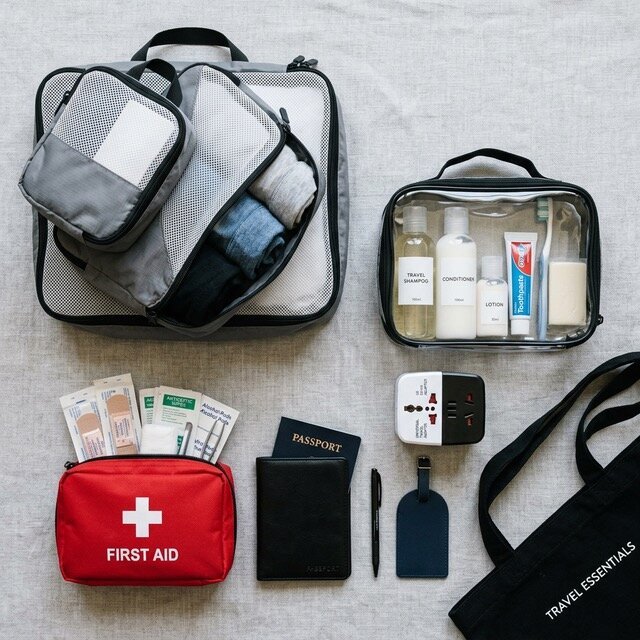
- Compact first-aid kit: Pack blister pads, ibuprofen, rehydration salts, and personal medications with pharmacy labels
- Reusable menstrual products (cup, period underwear): Reduce waste while keeping everything carry-on compliant
- N95 or FFP2 masks (Ã2â3): Still useful on crowded transit; airlines allow personal respirators
> Pro tip: Solid toiletries, including bars, tabs, and sticks, bypass 3-1-1 limits. See Packing Hacks for Toiletries for specific products.
—
Luggage & organization systems
Choose the right shell
- Carry-on mindset: Choose a 35â40 L backpack or 21-inch roller with three-sided compression
- Materials: Look for 400 D+ ripstop nylon or a polycarbonate blend for a light, durable shell
- Accessibility: A clamshell design opens flat and makes security checks quicker
Inside the bag
1. Compression cubes (3â4): Sort them by type, such as tops, bottoms, and intimates. Add colored stickers to the sides so you can spot each cube quickly
2. Dry bag (10 L): Hold swimsuits, muddy shoes, or other wet items
3. Quick-grab pouch: Keep your phone, lip balm, and earplugs together in a pouch that fits a seat-back pocket
4. Electronics organizer: Use elastic loops and a Faraday sleeve for privacy
5. Clear quart-size liquids bag: Keep it TSA 3-1-1 ready and place it at the top of the pack for one-hand access
—
Clothing capsule: the 4-3-2-1 formula
| Category | Quantity | Material focus | Rationale |
| ————— | ——– | ————————————- | ——————————— |
| Tops | 4 | Merino or Tencel blends | Odor-resistant, air-dry overnight |
| Bottoms | 3 | Stretch nylon or hemp | Dual-use: trail to dinner |
| Shoes | 2 pairs | Lightweight trainers + casual loafers | Covers 95% of scenarios |
| Outer layer | 1 | Packable waterproof shell | Weather insurance |
Color palette: Use 80% neutrals and 20% accent colors to maximize mix-and-match options.
Inclusive sizing: Brands like Uniqlo U and Patagonia offer extended and adaptive fit ranges.
—
Footwear nuances
- Main pair: Choose 8â12 oz breathable sneakers with removable insoles for easy orthotic swaps
- Secondary pair: Pack fold-flat loafers or minimalist sandals weighing <10 oz
- Optional: Add compact water shoes (<5 oz) if your itinerary includes reefs or waterfalls
—
Tech & connectivity (2026 TSA verified)
| Device | Weight | Must-have? | Justification |
| —————————– | —— | ————————- | ————————————- |
| Smartphone | 6â8 oz | â | Navigation, translation, eSIM |
| Power bank (10,000 mAh) | 7 oz | â for travel days >6 h | TSA <100 Wh rule compliant |
| 65W GaN charger | 3 oz | â | Powers laptop + phone; global voltage |
| Noise-cancelling earbuds | 2 oz | Reduces in-flight fatigue | Improves sleep on planes |
| Lightweight laptop/tablet | 1â2 lb | Only if work-critical | Adds weight and bulk |
| Backup USB-C cable | 0.5 oz | Peace of mind | Cables fail unpredictably |
Security: Enable a 2FA hardware key. If privacy concerns you, store a dummy phone number for hotel paperwork.
—
In-transit comfort & wellness
- Inflatable neck pillow (2 oz): Packs to palm size and offers adjustable firmness
- Compression socks (15â20 mmHg): Reduce DVT risk on flights >4 hours
- Electrolyte tablets: Replenish fluids after the dry cabin air takes its toll
- Blue-light-filter glasses: Support your circadian rhythm when screens dominate the flight
- Mindfulness app offline library: Provides breathing tracks for turbulence anxiety
—
Personal safety & privacy gear
1. Door-stop alarm (3 oz): A 100 dB siren can deter unwanted hotel entry
2. Small LED flashlight (USB-C rechargeable): Helps with low-light navigation
3. VPN subscription: Circumvents censorship and protects banking sessions
4. AirTag or Tile tracker: Monitors checked luggage, if you want the extra peace of mind
5. TSA-approved lock: Fits most luggage zippers; choose a 3-dial or NFC unlock
—
Sustainable & inclusive choices
| Swap | Traditional option | Sustainable upgrade | Benefit |
| ———————— | ———————— | ——————— | —————————————- |
| Plastic toiletries | Liquid shampoo bottles | Solid bars | Zero leaks, less waste |
| Single-use cutlery | Disposable utensils | Titanium spork set | Cuts landfill waste |
| Fast-fashion tees | Generic synthetic fabric | Fair-Trade merino | Ethical labor, longer service life |
| Gendered soap scents | Heavily perfumed bars | Neutral-scent castile | Better for scent-sensitive travelers |
—
Sample 7-day carry-on-only beginner packing list
Documents and Money (0.3 kg)
- Passport, visa, insurance summary, two credit cards, $100 local cash, printed itinerary
Clothing (2.2 kg)
- 2 merino tees, 1 performance polo, 1 lightweight sweater
- 1 travel dress/button-down
- 2 stretch pants, 1 athletic short
- 5 moisture-wick briefs, 4 pairs socks (1 wool)
- Packable rain shell, sun hat, quick-dry buff
- Trainers, loafers, flip-flops (optional beach days)
Toiletries and Health (0.8 kg)
- Solid shampoo bar, soap sheets, mini deodorant, SPF 50 reef-safe sunscreen stick
- Microfiber towel, mini brush
- First-aid: meds + blister kit, insect repellent wipes, N95 masks (Ã2)
Tech (0.6 kg)
- Phone + GaN charger, power bank, earbuds, universal adapter, USB-C cable, eSIM QR printout
Organization (0.8 kg)
- 3 compression cubes, spare tote bag, TSA lock, door-stop alarm, silicone collapsible bottle
Total weight: ~7 kg (15 lb) â comfortably under most global carry-on limits (typically 7â10 kg)
—
Frequently asked questions
Q: Should I buy travel-size toiletries or buy on arrival?
A: For liquids <100 mL, buy them at your destination to save weight. Still, pack the first 3 days' supplies. Rural areas may not carry fragrance-free or hypoallergenic options.
Q: What about cold climates?
A: Layering beats a bulky coat. Add a 90%+ down jacket that packs to 1 L, plus merino base layers. Swap sandals for insulated boots.
Q: Do packing cubes really help?
A: Yes. Peer-reviewed ergonomics research (University of Sydney, 2023) found that packing cubes reduced item-search time by 40%. They also compress air gaps and save 10â15% of your available volume.
Q: What if I get caught without something important?
A: Most developed destinations have 24-hour pharmacies, laundromats, and convenience stores. Pack only items you can’t easily replace locally, such as prescription meds and specific tech.
Q: How strict are airline weight limits?
A: Some carriers, including ANA, JAL, and Cathay Pacific, use scales. European low-cost carriers often rely on physical sizers. Check your airline’s policy and leave a 1 kg safety margin.
—
Departure-day checklist (15 minutes)
1. Charge phone & power bank to 100%
2. Enable lost-device mode; note IMEI
3. Photograph luggage contents (insurance proof)
4. Hydrate: 500 mL water + electrolyte tab
5. Empty home trash; switch off appliances
6. Confirm boarding pass timezone (avoid AM/PM confusion)
7. Snap passport-visa-insurance trio; store offline copy
8. Verify REAL ID status (US domestic flights)
—
Final thoughts
Packing light is a skill, and it improves with every trip. Start with this beginner travel essentials list, then adjust it after each journey. Follow 2026 TSA and REAL ID rules, review your kit quarterly, and you’ll carry less without giving up the items you actually use. Bon voyage!
—
Related beginner & travel resources
Essential packing guides
- Travel Packing Tips â fundamental principles for all trips
- Carry-On Packing Tips â general carry-on optimization
- Travel Essentials Checklist â universal must-haves
Specialized packing
- Business Travel Packing Tips â professional travel
- Family Vacation Packing List â traveling with kids
- Backpacking Trip Packing List â adventure travel
- Weekend Getaway Packing Tips â short trips
Advanced techniques
- Space-Saving Packing Hacks â make the most of your luggage space
- Packing Cube Travel Hacks â practical organization strategies
- Suitcase Packing Organization Tips â a systematic approach to packing